Acupuncture According to the Philosophy of Heavenly Stems & Earthly Branches: The 12 Earthly Branches (dì zhī) & The Deep Qi/Energy
3.5-day Recorded seminar
For a long time, the individual constitution of Man/Woman/Human/Person (hereafter referred to as Man in all text below) and the related destiny were elements in Chinese medicine that could not be worked on. They were fixed at birth. The Jing Luo, the connection between Heaven and Earth in Man, the system that connects Man to other people and its environment, was the only system that could be influenced. The constitution and destiny were only data. In the course of history, it became clear that the challenges of life, the responsibilities of people themselves and the free will of Man do have an influence on individual constitution and destiny.
Diagnosis and treatment according to the philosophy of Heavenly Stems (tiān gān) & Earthly Branches (dì zhī) are based on the cycles and rhythms of life by which it is possible to find the Qi configuration at the time birth, which defines the stronger and weaker aspects of the constitution. The Earthly Branches in the birth chart Qi template helps to understand the individual physical-emotional-mental development of people, the challenges and (im)balances of the Qi circulation due to the answers to these challenges, and the resulting health or disease.
The Earthly Branches describe the circulation of Qi at the level of time and seasonal change and are the basis for the organ clock and the Jing Luo. The Qi in the channels flows in the order of the Earthly Branches.
Understanding the characters and meaning of the Earthly Branches (Year, Month, Day and Hour) with their related hexagrams help us to deepen our understanding of the Jing Luo, the constitution of Man and are guidelines to focus treatment strategies on individual possibilities together with the dynamics of individual diseases. This helps us to focus treatment on people with a disease, instead of diseases only.
In this 3-day intensive recorded seminar on the “12 Earthly Branches”, we discuss each Earthly Branch in relation to its Chinese character and its related hexagram. We cover the concepts of Seasonal & Deep Qi/Energies, Like & Unlike Qi, the relationship of each Earthly Branch’s Hexagram to its inverted Hexagram (Husband-Wife relationship) and Hidden Stems. This is a very clinically oriented seminar, with practical implications, and the clinical use of each of these concepts and related Pulse Diagnosis. The teaching conducted was theoretical combined with hands-on training in diagnostic tools and setting up treatment strategies.
This recorded seminar is part 2 in a 3 part series, however, each recorded seminar in this series does not require the attendance of the previous recorded seminar to attend, due to each recorded seminar covering unique material that can be used separately in clinical application. However all 3 recorded seminars give the complete system to work with, and it is recommended that you attend each in the series, live, or access the online recordings we have on offer.
WHAT YOU WILL LEARN:
After an introduction about the Stems and Branches approach:
- The place of the Earthly Branches in this system, related to the birth chart
- The difference between Northern and Southern hemisphere to find the Earthly Branch of the year and month
- How to use the Earthly Branch of the year and month of the date of birth and current time
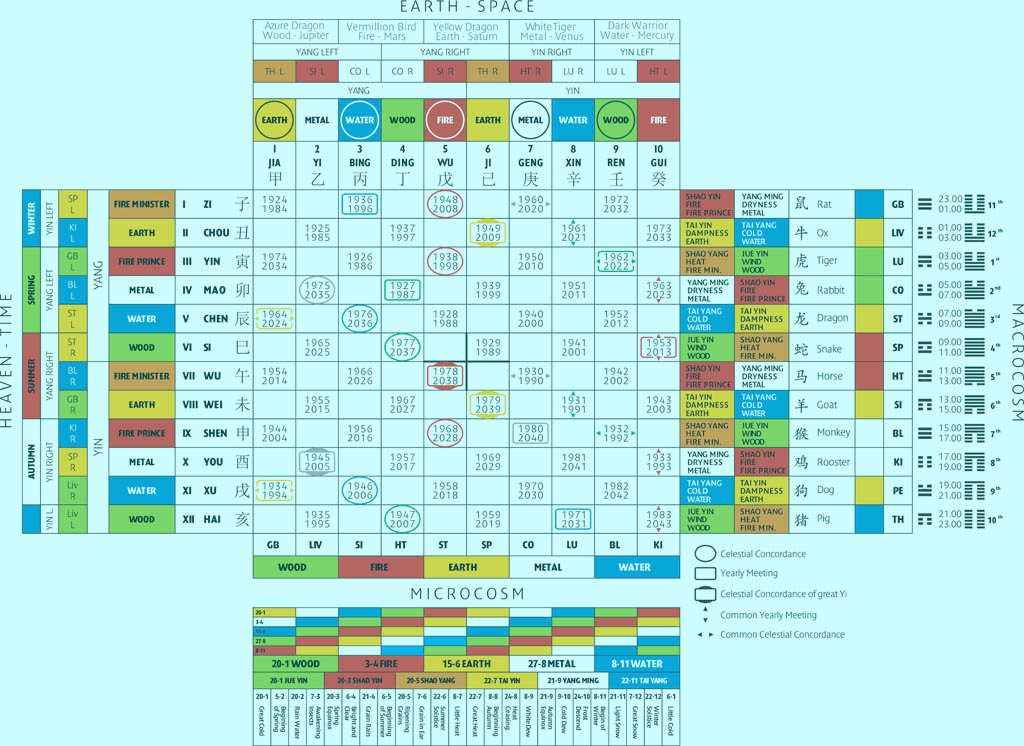
- 12 Earthly Branches, Chinese character, meaning, Seasonal Qi, related channel and Hexagram
- The Yellow River map, He Tu, and its relationship to the 12 Earthly Branches
- Deep Qi/Energy and the differences with Seasonal Qi/Energies
- The function of Deep Qi/Energy points
- How to apply Like Qi and Unlike Qi in treatment
- How to effectively apply the 4 Possibilities [this section of the class is bridging material for those who have completed the previous Part 1 of 3 of the complete curriculum- The Great Movements (dà yùn) & 10 Heavenly Stems (tiān gān), which is also available as online training].
- Hexagrams- the meaning of numbers in relation to the 12 Earthly Branches and diagnosis
- The meaning of inverted Hexagrams and related Earthly Branches in diagnosis and treatment
- How to use the hidden Heavenly Stems in relation to the 12 Earthly Branches
- Significant focus on pulse diagnosis and acupuncture treatment of the Earthly Branches and the Deep Qi/Energy and its consequences
“Treat people not diseases” – Dr. J.D. van Buren
“Treating patients using a deep understanding of the application of Classical Chinese philosophy to achieve outstanding clinical results. This is the type of Classical Acupuncture/diagnostics you always thought you’d be studying when you first commenced your Chinese Medicine education…….”
Peter Scarselletti | Director of Qiology
Outline of Stems & Branches Philosophy
Chinese philosophy describes a Human Being as standing between Heaven and Earth, being influenced by the cycles and rhythms of Heaven and nourished by Earth. Man assimilates these influences but also has an independent life, a free will, being able to conduct his or her life as an individual.
The philosophy of Stems & Branches, in the Classics, is described as the philosophy of 5 Movements and 6 Qi. In this context, “Movements” describes the many different cycles and rhythms, and “Qi” describes the inter-relatedness of everything that exists. By understanding this, one understands the life manifestation of the Universe as we perceive it, which is cyclical and in constant change and how to conduct his or her own life in harmony with universal life.
As a human being, depending on the time we were born, we have a certain character, which is determined by the cycles that were active or passive at that very time. Knowing about his or her own character and understanding it enables one to be oneself and live in harmony with the movement and rhythms of the Universe. One can adapt to constant change while staying true to his or her innate character.
As a human being, we are also born with a certain heritage, which comes from our ancestry. We are also in constant exchange and under the influence of our environment, social and environmental, and through this we develop a personal life, based on thoughts, emotions and desires.
This gives us certain challenges in life and these can be mental, emotional and physical. The way we deal with these challenges determines how we experience life.
The knowledge of our own constitution and the way it interacts with the changes given by the cycles of the Universe can give us guidance of how to conduct our lives and how to deal with our challenges so we can experience the fullness of life.
We will step out of our personal experience of life, where we are separate from the world around us and realise that we are part of a whole, which is called life, interacting with our environment in a meaningful way and giving something back to life itself
We can see that treatment according to the philosophy of Stems & Branches is not focused on the treatment of pathologies only, but on harmonising internal and external life so our patients can deal with their own challenges and lead a responsible life.
By understanding the constitution of our patients and the cycles and rhythms of life, treatment according to the philosophy of Stems & Branches will open certain doorways for change and enable them to make better choices in life. This process always involves a certain growth and development for the patient.
More important than an insight into how to treat our patients, the study and application of Stems & Branches philosophy imply self-understanding through self-reflection and internal development. It requires that we live our lives according to this philosophy, not in a dogmatic manner but through a deep understanding of our self and life. Only then will our own life, our interaction with our environment and treatment of our patients not be based on an outward projection of our own personal challenges.
The study of Stems & Branches philosophy will give us the tools to embark on this journey.
Acupuncture According to the Philosophy of Heavenly Stems & Earthly Branches: an explanation by Joan Duveen
“Treat people not diseases” (Dr. J.D. van Buren)
This is the core idea of the system known in the Western world as “Stems & Branches Acupuncture”. In the classic, Huang Di Nei Jing Su Wen, it is known as The 5 Movements and 6 Qi. The meaning and understanding of this philosophy is hidden mainly within the Chapters 66-73 of this classic.
This system allows the practitioner to understand the weaker and stronger aspects of peoples’ energies based on their date of birth and constitution, and the effect of weather, the seasons, diet, free will, physical and psychological circumstances, and how these factors influence health. This leads into knowing more directly the origin and nature of pathology and symptoms in patients and treating them effectively- be it preventively or curatively. Since diseases are based on constitutions and not on symptoms, it is the case that every disease will be treated differently, because the constitution of each person is different. This leads to unique constitutional and personalised treatments. Utilizing an understanding of the cycles of energy from Heaven and Earth and their relationship to the cycles of energy in Man (Human), allow us to affect, and protect the constitutional levels of patients’ energies to help them fulfill their destiny as human beings.
My teacher Dr. J.D. van Buren, who was one of the first people in the Western world practicing Chinese medicine based on Wu Xing, met, during his studies, Dr. Chang Bin Li, from Korea, who introduced him to this system of treatment. Most of what was given to him was mainly theoretical. It is a system not common to many practitioners, even today. It was banned in China during the Cultural Revolution. It is due to Dr. van Buren’s efforts that we are able to work with it in clinic today. Most of his practical life, besides treating patients, was dedicated to making this system available again for practitioners in acupuncture. “Treatments must be based on philosophy only” was one of his other famous expressions. “Many students learn a lot about Chinese philosophy, but have no tools to apply it” he said to me not long before he passed away in 2003.
I had the privilege to study with Dr. van Buren closely for 21 years and have promised him to continue his work. Since 1987 I have taught the Philosophy of 5 Movements and 6 Qi to hundreds of people in Europe and Israel as a Post-Graduate course and also to teachers who were trained to continue this work. There are also other colleges now that include Stems & Branches in their basic teaching program. The oral knowledge Dr. van Buren received was also given to me orally. Since he invited me to study with him, I have dedicated my professional life to developing a teaching program where people will be enabled to include this unique form of constitutional acupuncture into their daily clinical practice.
After multiple requests from Qiology’s director over the last years, I have agreed to offer these unique teachings to acupuncturists in Australia.
Joan Duveen


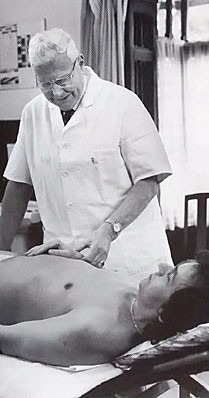
 Dr. J.D. van Buren (27th Nov 1921- 12th May 2003 | 81 yrs) can be considered to be one of the 20th Century’s most important influences on Acupuncture in the West, who pioneered bringing it to the Western World particularly assisting with it’s educational development in England, Holland, Norway, Denmark, Sweden, and even Australia. After a very colourful personal history in his formative years, followed by studies in nursing, naturopathy, osteopathy and homoeopathy, van Buren began his personal studies in acupuncture in 1952. Many years later he trained under Dr. Jacques Lavier in England in 1966 alongside contemporary J.R. Worsley, and then continued with further studies in Taiwan under Master Wu Wei Ping in 1968, where he received his doctorate, and later, studied in Korea.